
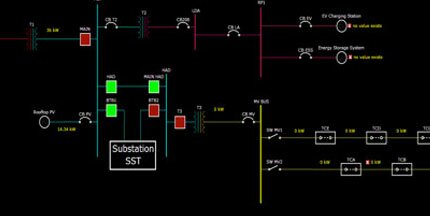
The FREEDM 1 MVA Green Energy Hub Microgrid represents Green Energy Corp’s participation in a project environment shaped by research, systems innovation, and the future of distributed energy management. On the company’s public projects page, this case is introduced with the phrase ‘The Future Renewable Electric Energy…’, directly linking it to the broader FREEDM initiative and to the next generation of grid architectures designed to support renewable integration, decentralized intelligence, and flexible control. Even though the public summary on the website is brief, the project title itself signals a highly ambitious scope: a one-megavolt-ampere green energy hub built to demonstrate how renewable generation, power electronics, storage, communications, and advanced control strategies can work together as a coordinated microgrid rather than as disconnected technologies.
In practical terms, a project like this serves as a bridge between theory and deployment. A green energy hub is not only a source of electricity; it is an environment in which multiple energy assets must be monitored, synchronized, and optimized under changing conditions. That requires a robust software layer, open communications, and a control framework capable of handling both normal and abnormal operating modes. Green Energy Corp’s broader positioning around GreenBus®, interoperability, and microgrid design strongly suggests that its role in the FREEDM project would have centered on enabling communication and coordinated control among distributed resources and grid-facing systems. This is the kind of work that becomes especially important when the objective is not just to connect equipment, but to validate a new architecture for resilient and renewable-heavy electric networks.
The strategic value of the FREEDM project lies in what it demonstrates for the future of energy infrastructure. Microgrids built around renewable resources need more than generation assets to succeed; they need the ability to maintain stability, respond to changing loads, and balance multiple objectives such as reliability, efficiency, flexibility, and scalability. A 1 MVA hub offers a meaningful demonstration scale for that challenge. It is large enough to reflect real engineering and operational complexity, while still focused enough to function as a model for future systems. This makes the project highly relevant for utilities, research institutions, advanced technology providers, and communities exploring how to transition from conventional power architectures to more distributed, digital, and resilient networks.
As expanded website copy, this project can be presented as a showcase of Green Energy Corp’s role in shaping the energy transition at a systems level. Rather than treating microgrids as isolated backup resources, the FREEDM 1 MVA Green Energy Hub Microgrid can be described as a platform for testing and validating the grid behaviors that matter most in the years ahead: interoperability, decentralized control, renewable integration, and intelligent coordination of assets at the edge. It reflects the company’s ability to contribute not only to commercial implementations, but also to strategically important projects that influence how modern power systems are designed. For visitors to the site, this case communicates that Green Energy Corp is equipped to work where advanced software, microgrid control, and energy innovation intersect—helping translate emerging concepts into real, workable infrastructure models.